Every advertiser eventually faces the same quiet question. You have a budget for sponsored posts, native placements or paid links, a seller sends a price list, and every site on it claims to be "high authority." Before money moves, you want a fast way to tell a site with real standing from one that simply sells space to anyone.
That is the job of a free tool that checks DA, DR and spam score together, and this article walks through what Domain Rating Check offers on its public pages as read on 9 November 2026, where it helps an advertiser, and where it stops.
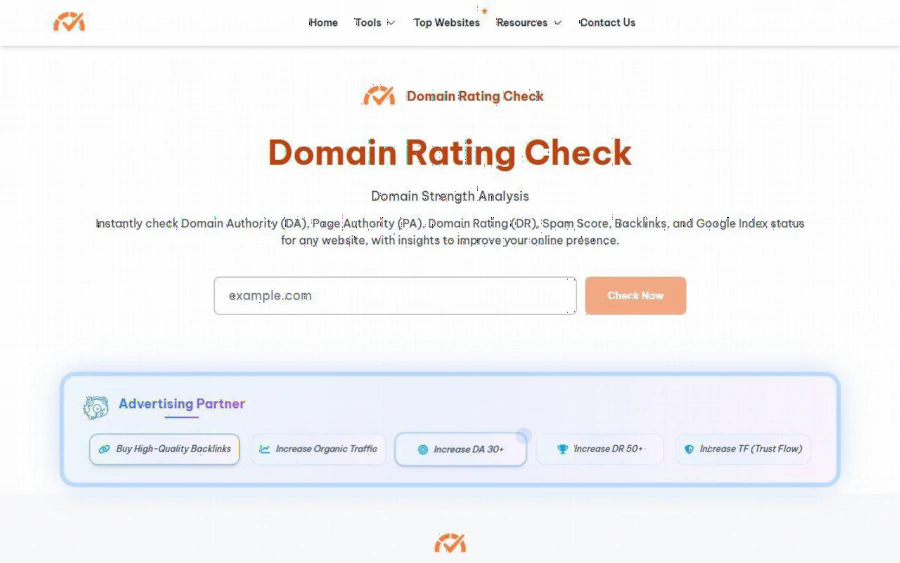
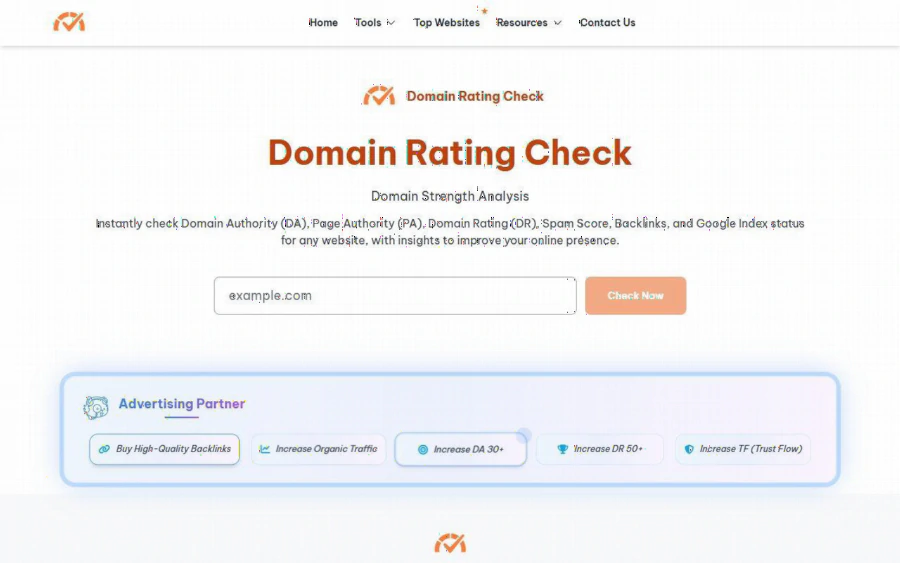
Domain Rating Check homepage with a domain box, a Check Now button and a list of metrics it reports
Why advertisers look at authority scores at all
Paid placements are priced on promises. A seller may quote a large audience, a strong "rating," or years of history, and none of it is visible in the invoice. Authority scores are not a perfect answer, but they give you a common yardstick to compare offers before you ask harder questions.
Three practical reasons they matter for advertising:
- Price sanity. If two sites charge a similar fee but one scores far lower, you need a reason to pay the same.
- Risk screening. A site with a high spam score can put your brand next to content you would never choose.
- Reporting. When you tell a manager why a placement was approved, a number from a public tool is easier to defend than a hunch.
None of these scores is a ranking factor you control, and none replaces judgment about the audience. They are a first filter, not a verdict.
What the tool reports
According to the homepage, you type a domain into a single box, complete a Cloudflare verification, and press Check Now. The page says it covers Domain Authority (DA), Page Authority (PA), Ahrefs Domain Rating (DR), Spam Score, backlinks and Google index status. It also lists organic traffic, Majestic links, Trust Flow (TF) and Citation Flow (CF), with deeper metrics available.
The site states the ranges plainly. DA and PA run from 1 to 100, DR from 0 to 100, and Moz Spam Score from 0 to 17. It also gives rough benchmarks: a DA of 50 or more is considered strong for most industries, a DR of 70 or more suggests an authoritative site, and a spam score should stay below 30 percent.
Treat those benchmarks as the vendor's rules of thumb. A local services blog with a DA of 35 can still deliver excellent leads, and a famous site with a big number can be a poor fit for a niche offer.
A worked example (illustration only)
Imagine a small online shop planning its first guest post budget. This is an invented scenario to show the process, not a real customer.
The owner receives three offers for the same price. Instead of choosing by the seller's description, they run each domain through the checker and note DA, DR, spam score and backlink figures in a simple table. One site shows a spam score near the top of the range, so it drops out. Another has a respectable DR but almost no organic traffic, which raises the question of who actually reads it. The third has modest numbers but a topic that matches the shop's products, and that one goes to the next round.
The tool did not make the decision. It made the questions sharper, and it took a few minutes instead of an afternoon of opening separate dashboards.
The Top Websites page as a reality check
Beyond single lookups, the site publishes a Top Websites ranking. When I opened it, the page showed November 2026 data and said it tracks 1,216 websites, ranked by organic traffic with organic keywords, referring domains, Trust Flow and a topical Trust Flow column. At the top sat wikipedia.org with 3.9 billion organic traffic and 4.1 million referring domains, followed by youtube.com and facebook.com. A dropdown filters the list by country.
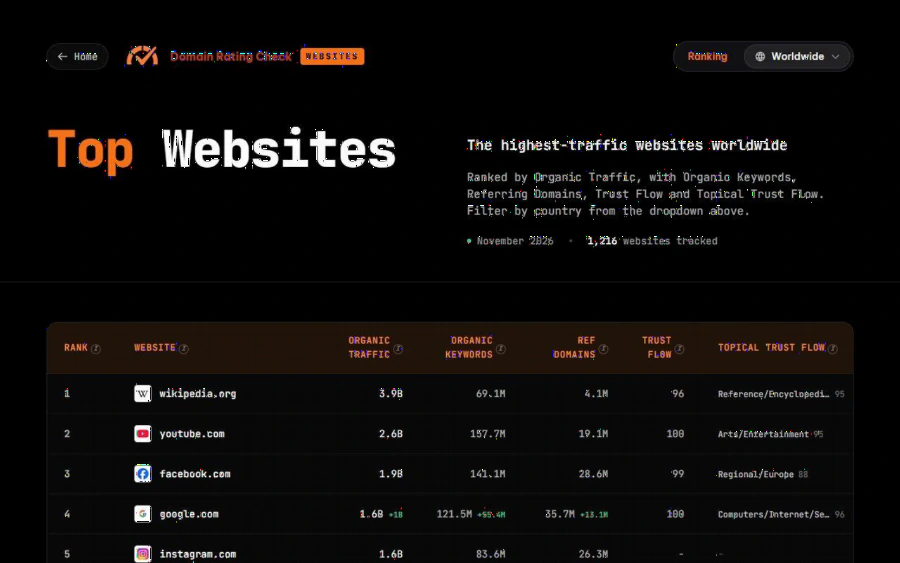
Top Websites ranking page showing organic traffic, keywords, referring domains and Trust Flow for the largest sites
For an advertiser this is useful as a calibration tool. When a seller says their site is "among the best," you can see what the genuinely large sites look like and judge whether the claim is modest or inflated. It is not a list of places to buy ads, and most of those giants do not sell guest posts at all.
Strengths and limits
What it does well
- One search box returns several scores, so you avoid juggling tabs.
- The metric ranges and benchmarks are written on the page, which helps beginners read the numbers.
- Separate pages exist for DA and PA, Ahrefs DR and Trust Flow, plus a blog and a Top Websites ranking.
- The homepage lists no plans or prices, and I did not find any quota stated, so a quick check does not appear to need an account. Verify that on your own visit, because terms can change.
Where to be careful
- The Cloudflare verification appears before each check, which slows a long list of domains.
- The site does not explain, on the pages I read, exactly how each figure is sourced or how often it refreshes, so treat the numbers as estimates and compare them across tools when a purchase is large.
- Scores describe a domain, not an audience. A site can score well and still be wrong for your product.
- The homepage also shows an advertising partner banner promoting backlink and traffic services. Do not confuse that with the checker itself, and apply the same scrutiny to any offer you see there.
Who should use it, and who should not
It suits marketers, small business owners, freelancers and agencies who buy or review paid placements and want a quick public check before asking for a proposal. It also helps beginners who keep hearing "DR" and "TF" and want to see them side by side.
It is a weaker fit if you need audited traffic, historical trend charts, or a full link analysis for a large campaign. In that case a paid suite and a direct conversation with the publisher are the safer route. Nothing here guarantees rankings, sales or placement quality.
A simple way to start
1. Collect the domains from your current shortlist of sellers.
2. Check each one and record DA, DR, spam score and backlinks in a spreadsheet.
3. Remove anything with a worrying spam score or an obviously empty footprint.
4. Open the sites that remain and judge them by eye: topic fit, recent posts, who the readers seem to be.
5. Ask the seller for sample posts and live examples before paying.
Ten minutes spent this way will not guarantee a good buy, but it will stop the most avoidable mistakes. Domain Rating Check gives you the numbers quickly. The advertiser still has to supply the judgment.